The Soil Orders – Histosols

This is the second of a series of blog posts where I will describe some of the interesting features of each of the 12 soil orders in Soil Taxonomy – the soil classification system developed for the US by the United States Department of Agriculture. Each order will be “profiled” (forgive the bad soils pun) in the order in which they are “keyed out” in Keys to Taxonomy.

Histosols

clayey, kaolinitic, dysic, isohyperthermic Terric Haplosaprist; Photo: SoilScience.info

Histosols are soils with organic matter as the primary parent material. They occur when conditions allow organic matter to accumulate at a faster rate than it can be decomposed. This is usually under wet conditions such as a wetland (think the Florida Everglades) or in areas where it’s just too cold for the microbial community to decompose plant material fast enough (think the Arctic Circle).

Histosols have organic surface layers at least 40 cm deep that are at least 12-18% organic carbon (not living roots) depending on clay content. Some frozen soils that were once classified as Histosols have been now reclassified as Histels once the Gelisol soil order was introduced.

Histosols occur where wet conditions exist because saturated conditions don’t allow air (and oxygen) to enter the soil profile, thus eventually creating anaerobic conditions. Under these conditions decomposition or organic matter is slowed, and what would have been converted into carbon dioxide by microbial respiration in dry conditions instead remains in the soil as organic matter. This organic matter builds up over time and eventually forms a Histsol.

There are different types of organic soil materials including fibric, hemic, and sapric soil materials. Fibric soil materials are organic soil materials that contain three-fourths or more plant fiber material after rubbing [to soil scientists, rubbing means rubbing the material between two fingers 10 times]. Sapric soil materials are organic soil materials that contain less than one-sixth plant fiber materials by volume after rubbing. Sapric materials will feel “greasy”. Hemic soil materials are in-between fibric and sapric.

Suborders

For Histosols, the formative element for the order is “ist”. As described by Buol, et al (1997) Histosols have five suborders and they are classified in the following order in Soil Taxonomy. Wassists are Histosols that are floating on top of free water. Folists are Histosols that formed not due to wet conditions, but from high rates of accumulation of organic matter (relative to decomposition). The rest of the suborders are classified based on the state of decomposition. Fibrists are Histosols with fibric materials, Hemists are Histosols with hemic materials, and Saprists are soils with sapric materials.

Occurence

As said above, Histosols form anywhere that has a rate of organic matter accumulation greater than decomposition.

Photo: USDA NRCS

At the scale of this map, it’s difficult to pick out many expansive areas of Histosols. However, they do occur throughout the world, but usually in small areas. This map of the US shows a better depiction of their occurrence.

Photo: USDA NRCS

Uses

Histosols are used for crop production and forestry, as well as wildlife and recreation. The organic material can also be harvested for horticultural potting soil and for heating and electricity. They can be production crop soils, however extensive drainage is required.

Unfortunately, drainage leads to subsidence. Subsidence is the loss of soil depth. Subsidence occurs when water is drained from the profile. The organic materials “float” in saturated conditions and become more compact when drained. Once drained, the soil begins to oxidize and microbes consume the organic matter and slowly turn it into carbon dioxide with time. Subsidence, as a rule of thumb, occurs at a rate of 1 inch of soil per year. This creates problems for drainage ditch maintenance and long term uses of agricultural soils.

Depth of Subsidence; Photo: USDA NRCS via University of Idaho

Histosols, when drained, are also vulnerable to fires. Here is a recent news story about a fire that occurred in Alligator River National Wildlife Refuge here in North Carolina <http://outerbanksvoice.com/2011/06/10/million-of-gallons-of-water-pumped-on-peat-fire/>. 

Histosol Fire, Photo: The Outer Banks Voice

Here’s an excerpt from that article:

Flammable organic peat ranges from a few inches to 8 feet deep in the ground, said the multi-agency team fighting the fire.

Because of the lack of rain, peat, which was once used as a fuel, continues to burn even when the surface fire is put out, according to the North Carolina Incident Management Team.

“The ground fire will continue until the fire consumes all the peat down to mineral soil, the fire burns down to a level of high moisture content, or the soil moisture level rises to the fire as a result of an extended heavy rain or pumping operations,” the team said in a statement Friday.

Histosol profile; Photo: USDA NRCS

My current research involves Histosols in a Carolina Bay wetland. The wettest part of the wetland (the center) is where the Histosols occur. They’re really interesting soils (I might be biased because I’m a wetland soils guy).

Some good Histosol info sources:

The USDA NRCS

Wikipedia

Buol, S., et al. 1993. Soil Genesis and Classification

Previously discussed soil orders:

Gelisols

Earth Day 2012 – Activity Ideas & I Heart Soil Campaign

Photo: NASA

Happy Earth Day everyone.

Earth Day is a holiday celebrated by people of all walks of life in a variety of ways. In the past I’ve celebrated it by doing trash clean-ups, educating the public about water quality using an ISU SWCC groundwater flow model, and more. I’m not planning any environment-related activity for today outside of this blog post and a long dog walk on a greenway trail, but I do participate in a variety Earth-friendly activities throughout the year.

If you’re planning some Earth Day activities, I encourage you to first read about the interesting history of how it started on the Earth Day Wikipedia page.

Here’s a couple of soil and water-friendly activities I suggest.

Build a rain barrel

Rain barrels are tanks that store rain water from a gutter downspout and saves that water for non-drinking water uses like watering garden plants. They can be constructed through mostly reclaimed products like used pickle barrels. There are multiple “how-to” videos on Youtube that will show you how. You can pick up a pickle barrel for $10 or $15 on Craigslist. They’re easy to build, and can be built for around $40.

Participate in a litter clean-up

Many organizations and municipalities will organize litter clean-ups. Litter clean-ups are easy, and are a very common Earth Day activity. Some places to find one that’s already organized include your local County Soil and Water Conservation District, the River Keepers, your local municipality, listings in your local newspaper, etc. For those of you geocachers, Geocaching.com has some CITO (Cach In Trash Out) events, in which many people focus on a local park, river corridor, etc and go geocaching in the area while carrying trash bags. Participants then remove any litter they come across along their way.

Start a garden

Gardens are a lot of fun. There’s also a sense of accomplishment when you can make a meal with food that you raised from seed. Gardener’s gain a sense of appreciation for soil and also where their food comes from. In addition, growing your own food cuts down on your carbon footprint by eliminating the transportation of the food that you grew, but would have bought from your local market.

Build a compost bin

If you are already a gardener, one way to cut down how much trash you create while adding nutrient rich material to your flower bed or vegetable garden is by composting all of your organic wastes (wasted food, newspapers, etc.). You can build a compost bin in your back yard as a weekend DIY project. Vermi-compost is also an option, which is where you compost paper and some food waste by letting worms “process” the waste. Once again, Youtube is a good resource for “how-to” videos.

Think of some lifestyle goals that are Earth-friendly

Earth Day is a good concept, but the message is lost if people are only Earth-friendly one day of each year. Some goals for a year-round Earth-friendly life style might be to:

    • Ride your bike or walk to work/school a few days a week
    • If biking/walking is an option, carpool to work/school
    • When shopping, choose “local” products with less packaging
    • Water your plants with used dishwater
    • Take short, warm (not hot) showers

Lastly, I just want to note that the Soil Science Society of America (SSSA) is relaunching their “I Heart Soil” campaign today. I encourage you to visit the campaign website and “like” their Facebook page

Stand Up for Ag!

A few months ago, a “writer” by the name of Terrance Loose wrote a piece for Yahoo Education entitled College Majors That Are Useless, and in that article listed several majors that are anything but useless. On that list agriculture, animal science, and horticulture were listed as three of the top five most worthless college majors. I question whether Mr. Loose has ever considered that his meat and potatoes might have come from somewhere other than a grocery store.

The four Land Grant University agricultural deans who authored "No Limits to the Value of an Agricultural Degree".

Luckily, the article has been pulled apart by the scenes by countless people in the agriculture and education professions. One counter was written by four deans of agriculture colleges at four major land grant universities (including a dean from my Alma Mater, Iowa State University) – No Limits to the Value of an Agricultural Degree. The article outlines the real outlook on agriculture degrees and explains how the job outlook for agriculture, animal , and natural resource scientists not only good, but there is a huge shortage in people with training in these fields. Unemployment for those disciplines is very low even in the current recession, and that unemployment is projected to be low at least for the next decade due to the demand of people with these so called “useless” majors.

A second notable counter to Mr. Loose’s article has been offered by an advocacy group called Farmers Fight, which was started by students at Texas A&M. They maid a great video to get the message out:

The video does a great way of succinctly expressing the inherent value of several major agricultural degrees in a way that shows how agriculture is relevant to even those who live in an urban setting. Farmers fight also has a blog, a Twitter feed, and a Facebook page if you would like to follow the effort. Please spread this video and help to make it go “viral”.

My take is this: everybody eats, we have a growing human population, there is only so much arable land on planet Earth. You tell me how “worthless” a degree may be from the agricultural sciences.

The Worst Hard Time

I recently finished a book entitled The Worst Hard Time, by Timothy Eagan. It is a book about the dust bowl, an epic environmental event that occurred during the great depression. A long term drought had settled on the great plains, the southern great plains especially, which in combination with plowing over of the prairie soil and grass caused massive wind erosion and storms called “dusters”.

This book does a great job of capturing every angle of the dust bowl. In writing the book, Eagan focused on the individual stories, and even quotes personal diaries. He also touches on the local, state, and national politics that occurred during that time during the Hoover and Roosevelt administrations. He explains the goals of different conservation efforts put into place for relief such as the soil conservation efforts lead by Hugh Hammond Bennett, the projects installed by the CCC, and the creation of the Soil Conservation Service (now the Natural Resource Conservation Service).

Photo: USDA ARS

The book, in my opinion as a soil scientist, and as an empathetic Midwestern farm kid, does a great job depicting the struggles farmers went through in that time, and the difficulties that farmers and government can have in efforts to stop erosion. I recommend this book to anyone who is interested in soil and environmental science, policy, drama, country living, and more. I gave it 5 stars on my Amazon Kindle review. Let me know what you think of it in the comment section below.

As this is my first book review on ColbyDigsSoil, I am starting a new rating system. I give this book 5 shovels.

Useful links:

The Soil Orders – Gelisols

This is the first of a series of blog posts where I will describe some of the interesting features of each of the 12 soil orders in Soil Taxonomy – the soil classification system developed for the US by the United States Department of Agriculture. Each order will be “profiled” (forgive the bad soils pun) in the order in which they are “keyed out” in Keys to Taxonomy.

Gelisols

A picture of a Gelisol profile. Photo: SoilScience.info

Gelisols, in a nutshell, are soils that are frozen. They are soils that have permafrost (frost, i.e. frozen soil, that is present year-round) within 100 cm of the soil surface, or have “gelic” material within 100 cm with permafrost within 200 cm of the surface. Gelic materials are mineral or organic soil that is present due to “cryoturbation”, or churning of the soil profile due to freezing and thawing.

Suborders

As described by Buol, et al (1997) Gelisols have three suborders including Histels, Orthels, and Turbels. [A quick note on how Taxonomy works. The formative element attributed to the soil order, in this case ‘gel’ from GELisols, always occurs at the end of the soil classification.Histels are Gelisols that have a lot of organic matter incorporated into the soil profile. They often occur in low lying, or wet areas. Turbels (from the Latin, turbides, “disturbed”) are Gelisols that are characterized by evidence of Cryoturbation. That means that they have one or more soil horizon that is irregular, broker, or distorted due to action of freezing and thawing. Orthels (from the Greek, orthors, “true”) include all other Gelisols that do not have high amounts of organic matter, or show low evidence of churning.

Characteristics

Gelisols can be very old soils. However they usually don’t exhibit much in terms of soil development due to short growing seasons, cold temperatures, limited plant growth, etc. An expert in Gelisols, Chen-lu Ping, from the University of Alaska Fairbanks can be seen in the next picture using a gas-powered jack hammer to “dig” a soil profile.

One thing that is interesting about Gelisols is that in some landscapes, they create a hexagonal pattern caused by the expansion of ice in cracks as shown in the following picture.

Gelisol 5
Gelisol landscape. Photo: Wikipedia commons

Occurance

Gelisols, as you can imagine, occur in areas where it is cold. For my US readers, you’ll only find them in Alaska.

Distribution of Gelisols. Photo from University of Idaho
US Distribution of Gelisols. Photo from US EPA
A picture of a Gelisol soil profile, and the landscape from which is was sampled. Photo: SoilScience.info

Use

In order to use Gelisols for human uses, many precautions need to be made – mostly to ensure that the permafrost stays frozen. This would be precautions like putting buildings on stilts so that the air directly above the soil stays cold, avoiding leaving open holes in them so that they don’t thaw out from the exposed soil profile, etc. Generally they are best left wild, or used for habitat. Wildfire and human activity can cause permafrost retreat, and  as Buol et al (1993) puts it, “change a nearly level terrain into a hilly thermokarst one”.

Good sources for further information

USDA Natural Resource Conservation Service

Wikipedia

Buol, S., et al. 1993. Soil Genesis and Classification
Colby Featured on Soilduck’s Sunday Soil Scientist

Fellow soil scientist Jess Drake runs a blog called soilduck. Jess has a weekly feature called the Sunday Soil Scientist which focuses on the bio of a soil scientist from around the world. She was nice enough to do this week’s feature on me which you can read at this link. Soilduck is a great blog with lots of interesting stories. Jess also runs The #Soil Daily, a paper.li website that features the best stories posted on Twitter with the #Soil hashtage. Both websites are great resources and I encourage you to check them out on a regular basis.

Thanks Jess for the feature!

ColbyDigsSoil Now on Facebook

As a way to better market this blog and to foster more interactions with readers there is now a Facebook fan page for ColbyDigsSoil.com. You can “like” the blog by following this link.

The Art of Soil Color

Soils from around the world differ greatly. One reason for that is color, as evidenced in the header of this website. Colors were first standardized by Professor Albert H. Munsell on a system with three components: hue, value, and chroma. It was standardized primarily for industry. As an example, the orange thread used in the stitching of your Levi jeans has an exact hue, value, and chroma. A factory can call a supplier and order that exact same thread by stating what hue, value and chroma of the thread they want. The United States Department of Agriculture later adopted the Munsell system as their official classification of soil colors, and later helped develop the Munsell Soil Color book.

Source: Wikipedia Commons

Let’s talk about the three characteristics of soil color. Looking at the figure above, think of it as a wagon wheel. You can think of hue as a spoke, and that spoke would be called yellow, red, blue, green, etc. It includes all of the colors of the color wheel we all learned about in elementary school art class.

Value is the position on the axle of the wagon wheel. It is a measure of how much light is reflected. Since pure light is white, if a color has a high value it would reflect almost everything. If it has a low value, it would adsorb the light and look dark. Think of a hot summer day when you wore a black shirt. The shirt got really hot right? That’s because the black shirt was absorbing more light from the sun which heated you up. Same concept here.

Chroma is the concentration of color, or how far from the axle you are on the wagon wheel. Low chroma appears grey and is close to the center of the wheel next to the axle. High chroma gives you bright colors that are far away from the center. Think of taking red grape juice (pardon me while I keep it appropriate for all audiences) in a glass. Pure wine would have a high chroma and would be a very bright red. if you dilute it with water, there would be less color, or a lower chroma. If you add a lot more water it would dilute it so much that you could barely tell it is red. That would be a low chroma color. That’s the basics of soil color. You now might be asking “how does this relate to soil?”

Soil gets its color primarily from two components – iron and organic matter. Oxidized iron gives soil red or yellow colors. If there is a lot of oxidized iron, those colors will be very bright. If there is very little iron, or none at all, a soil could appear grey. Thus the more oxidized iron present, the higher the chroma and the brighter the color. The minerology is what provides the hue (red, yellow, or a mix of red and yellow). In the three soil profiles below (pictures from SoilScience.info) we see a soil with a red hue (left), a yellow hue (center) and low chroma (right). Iron oxides create the high chroma red and yellow, while the reduction of iron combined with movement of that reduced iron creates what we call a depleted matrix, or a matrix that has low iron, creating grey colors. We’ll talk about that process in a future blog post.


Organic matter is the other coloring agent in soils. For this, think of potting soil or peat. This highly organic material is very dark in color, right? Organic material (decayed leaves, roots, animals, etc.) leads to a lower value making for a darker color. That is why the surface horizons of soil are usually darker, because this is where the roots are, making for more organic matter, and soils lower value in terms of color.

A soil with a low value. Honga series. Source: SoilScience.info

The Munsell soil color book consists of multiple pages with a series of different color chips. It is set up so each page is a specific hue. The value increases as you move up the page. The chroma increases as you move from left to right.

Source: edwardtufte.com

The color of each chip is reported as Hue_value/chroma. You can remember the order of hue, value, and chroma by remembering the acronym HVAC for heating, ventilation, and cooling that plumbers work on in your house. For us, its Hue, Value, And Chroma. For the picture above, the chip in the 5th row from the top, and the 4th column from the left would be 10R 4/4. We can look at the opposite page and see the corresponding dot and “common color” name which is “weak red”. A hue of 5 indicates hue purity. For example, a hue of 5R means that the only hue present is red, a hue of 10YR means a 50/50 mixture of yellow and red, and a hue of 5Y means pure yellow. Most soils are on the 10YR page so that’s usually the starting point when soil scientists are trying to match a soil to a color chip.

A soil color book is best used under well lit conditions using natural light (i.e. near high noon  with few clouds or shade). Sunglasses should not be used. Also, daylight near dawn or dusk will give off a more yellow light which may effect the color chip choice. Here’s an example of some soil scientists using a color book correctly:

Photo: Jim Kelly via SoilScience.info

Soil color is really what makes soils beautiful and unique. In a future post I will discuss how soil scientists use soil color to make inferences about how soils were formed, and how soils could be used.

Good soil color resources:

Envirothon Training – 2012

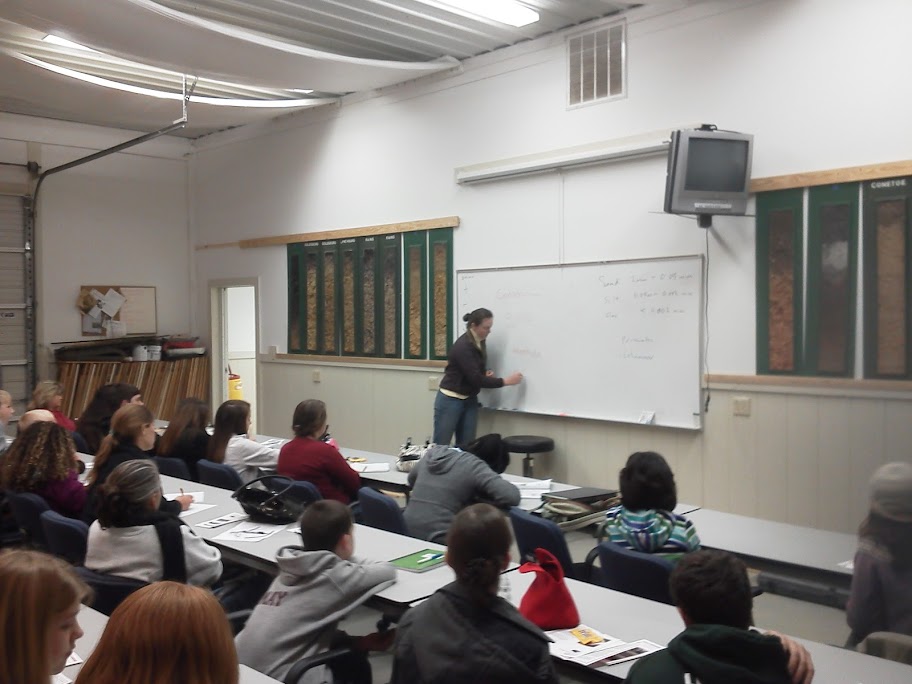
Since I arrived at NC State for my graduate studies, I’ve helped out every spring with teaching a “crash course” on soil science to local Envirothon competitors. Envirothon is an academic competition for middle and high school students. They take five exams, one each on soil science and land use, forestry, wildlife, aquatic ecology, and a current environmental topic. You can read more about the competition on a previous post on this blog about Envirothon.

Virginia teaching about soil erosion

I’ve teamed up with fellow soil science graduate students from my department, and with fellow members of our student chapter of the Soil and Water Conservation Society. This year I had the help of a professor in soil science, David Lindbo, and a fellow grad student and SWCS member, Virginia Brown. We started off with Dr. Lindbo discussing why soil is important. Then I went in to soil horizons, soil color, and soil development in relation to the 5 soil forming factors. After that, Virginia gave a talk regarding soil erosion and soil and water conservation. We ended the indoor portion of the soils crash course with a hands-on lesson on how to use a county soil survey report. We ended the day with a tour of some best management practice (BMP) experiments that Virginia’s research group has been evaluating.

Colby presenting soil horizons with a soil monolith

These students are great. They rival, and many times exceed the abilities and knowledge of many of the undergraduate students I’ve taught. In other words, they’re smart cookies! We had 19 students in attendance, with over a half dozen parents and group leaders. They have their regional competition on March 25. I wish them all the best of luck. The top teams in the regional competition go to the state competition. The top teams at the state competition will compete in the national competition this summer and will compete for scholarships.

Virginia presenting how a silt fence helps trap sediments on a construction site
Virginia showing how a construction site sediment retention pond works

A Spade is a Spade… or Sharp Shooter

Some examples of shovels and hole digging equipment. The tile spade, a.k.a. sharp shooter is on the left. Photo: familyhandyman.com

I’ve been in grad school at NC State for almost 4 straight years now. Ever since I’ve arrived in North Carolina, I’ve thought that the use of the word “sharp shooter” to describe a tile spade (what I’ve always refferred to as a spade; see picture on right) has been kind of weird. I never made the connection to it’s regional “sharp shooter” name until yesterday. While I was TA’ing a soil classification class yesterday, the professor for the class, David Lindbo, finally explained to me why people in North Carolina, specifically soil scientists in NC, call it a sharp shooter.

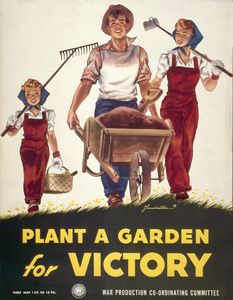
"Sharp shooters" are carried similarly to the rake and garden hoe in this victory garden poster. Photo: naturemoms.com

A sharp shooter is an accurate rifleman, i.e. a sniper. When walking, a rifleman sometimes carries his or her rifle on their shoulder with one hand holding it in place. Soil scientists hold their spades the same way when they’re not using it, or are walking to where they plan to sample soil, thus their spade is their rifle/sharp shooter, hence the name. See the poster (left) to see the two ladies in red carrying a rake and garden hoe in the same manner.

This may not seem like that big of a deal to most of you, but I’m obsessed with finding meaning behind the origin of certain words and their uses. It’s been bugging me for 4 years, and now I know.

Now I’m curious if this is just a regional thing, or a soil scientist thing that is nationwide, or worldwide. If you do or don’t use the term “sharp shooter” in reference to a tile spade, please say so in the comments section, and where you’re from.